The clarinet. The very name conjures images, doesn’t it? Smoky jazz clubs, maybe. Or the refined elegance of a Mozart concerto. But pigeonholing this instrument? That’s a huge mistake. The clarinet is a true chameleon. From its rather unassuming beginnings, it’s become a cornerstone of classical and contemporary music. A remarkably adaptable, expressive voice.
As a music historian – and a clarinet enthusiast ever since my decidedly unstellar high school band days – I’ve been captivated by the clarinet’s journey. It’s a story of constant evolution. Driven by both technological leaps and the sheer, boundless creativity of composers eager to unlock its sonic secrets.
Mozart’s Embrace: A Star is Born
The clarinet’s ascent in the Classical era? It’s totally intertwined with Wolfgang Amadeus Mozart. Sure, earlier versions of the instrument existed. But Mozart? He got it. He saw its potential. He wove it into his orchestral tapestries and, most famously, composed the Clarinet Concerto in A major, K. 622, and the Clarinet Quintet in A major, K. 581. These pieces? Absolute cornerstones. Showcasing the clarinet’s lyrical beauty and agility.
Weber: Beyond the Classical Canon
But Mozart wasn’t a lone wolf, of course. Composers like Carl Maria von Weber further cemented the clarinet’s place. Think of his two clarinet concertos and the Concertino, Op. 26. Weber really understood the instrument’s dramatic capabilities. He wrung every last drop of emotion from it, exploiting its vast range and dynamic contrasts. Virtuosity meets profound emotional depth. That’s Weber.

Chamber Music’s Secret Weapon
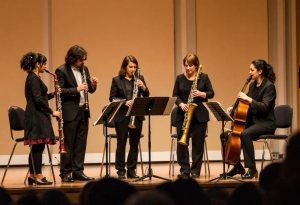
And its ability to blend? Seamless. The clarinet was a natural fit for chamber music. From Mozart’s quintet (mentioned above) to Brahms’s autumnal Clarinet Quintet in B minor, Op. 115, the clarinet’s warm, expressive tone added a unique color to the ensemble.
20th Century Clarinet: Breaking the Mold
The 20th century. An explosion of new styles and techniques. And the clarinet? It didn’t just keep pace. It led the charge. Composers like Igor Stravinsky, with his Three Pieces for Clarinet Solo, really pushed the envelope. Exploring atonality, extended techniques, and unconventional timbral effects.
Schoenberg: Serialism and Sound
Arnold Schoenberg, a key figure in serialism, also embraced the clarinet. Pierrot Lunaire, his song cycle for voice and chamber ensemble, features the clarinet prominently. Showcasing its ability to navigate complex, often dissonant, harmonies.
Jazz Age: A New Kind of Cool
Beyond the concert hall, the clarinet found a new home: jazz. Benny Goodman, Artie Shaw, Sidney Bechet. These players transformed the instrument into a vehicle for improvisation and sheer virtuosity. Its agility and expressive range? Perfect for the fast-paced rhythms of swing and bebop.
Contemporary Clarinet: Legacies Continue
The clarinet’s story doesn’t end in the 20th century. Not even close. Contemporary composers are still exploring its potential. Pushing the boundaries of what’s possible. Kaija Saariaho, with her ethereal works, has used the clarinet’s unique timbral qualities to create hauntingly beautiful soundscapes.
Beyond the Notes: New Sounds, New Techniques
The rise of extended techniques – multiphonics, flutter-tonguing, microtonal inflections – has really expanded the clarinet’s sonic palette. Once considered avant-garde? Now, these techniques are increasingly integrated into mainstream compositions. Proof of the instrument’s remarkable adaptability.
Innovation in Design: The Future is Now
And let’s not forget the evolution of the clarinet itself. New designs, alternative key systems, innovative materials… It’s all opening up new avenues for exploration. Players can achieve greater technical facility and explore a wider range of timbral possibilities.
Why the Clarinet Endures
So, what is it? What is it about the clarinet that has captivated composers and performers for centuries? Is it its versatility? Its ability to be both lyrical and virtuosic, elegant and edgy? Or is it the clarinet’s uniquely human voice? Its capacity to express joy, sorrow, longing… the whole spectrum of human emotion?
A Bright Future
Whatever the reason, the clarinet’s future is bright. As long as there are composers willing to experiment and performers eager to push boundaries, the instrument will continue to evolve and inspire. It’s a testament to human ingenuity and the enduring power of music.
From Mozart’s refined elegance to the experimental soundscapes of today, the clarinet’s journey is a testament to its enduring versatility and profound impact. An instrument that continues to surprise and delight. Its story? Far from over.
The woodwind quintet: it’s a cornerstone of chamber music. But have you ever stopped to think about its story? It's Read more
